We did not bring any decorations with us to Germany (plus, only one or two would fit on this tiny tree anyway), so I made ornaments from scratch, using cardstock, embroidery floss, Capri-Sonne pouches, a juice box, and magazines. I also made a decorative box to catch excess water. I am quite fond of our little Christmas tree:
Thursday, November 29, 2012
O Tannenbaum!
Fuβfetifisch
Sean and I were headed toward a Weihnachtsmarkt in downtown Prenzlauer Berg when I was arrested by a curious sight: a shop room with fish tanks on the floor. What is this place? I wondered. Well, on closer examination, I noticed a small sign with fish surrounding a foot, and then I realized the tanks were next to cushioned box seats, with the tank placed where one's feet would rest. This is perhaps the strangest "spa" treatment I've ever seen! I think I've watched program on medical uses of animals that mentioned fish like these, but I never imagined I would actually come across this service in our neighborhood here. On the one hand, I am slightly disgusted by the thought of putting my feet in those tanks and allowing fish to feast on my dead skin cells. There are a lot of fish, which means a lot of fish poop, and other people's feet would have been in there... Plus, I don't like thinking about dead skins cells, much less organisms consuming them. And yet, I can't help being terribly intrigued... For just 12 euros (about $15.50), I could take part in this queer cleansing for twenty minutes.
For those who are equally intrigued, there is a web-site for Fuβfetifisch. You'll find images of the set-up I described, and people enjoying their role as fish sustenance-provider. The translation is horrible, but from what I can understand, they use a very specific species: Garra rufa (commonly known as doctor fish or nibble fish). The company's site claims that the fish are native to Turkey, where they inhabit warm rivers too hot for plants, so they receive their protein from human bathers. The salon feeds the fish, but feet provide a snack for the fish for up to four times a day.
I discovered that you can Google nibble fish, and a lot comes up. Wikipedia offers a disappointingly short article, but it at least provides some more detail, like how the fish's range extends across Northern and Central Middle East, so they can be found in Turkey, Syria, Iraq, and Iran. It also answers one of my biggest questions: what do the fish naturally eat? Well, apparently it's algae and microorganisms (the article also states the fish "slough off" dead skin, not actually consume it). From a quick internet search, I also learned that fish baths are quite controversial--they are even banned in some states. Their use triggers questions of sanitation and safety for humans (how does one sterilize an animal?), and health for fish.
Monday, November 26, 2012
Baggers Missed
I have a new-found appreciation for grocery store baggers. In the States, baggers are ubiquitous; in fact, I'm having a hard time recalling any grocery stores without them. All my life, I took the bagger for granted. I never considered that this service is a courtesy, a nice bonus for the customer--not a necessity. In Berlin, you are expected to bag your own groceries--and those
check-out counter employees have speedy check-out down to an art. There
is no mercy for slow baggers--not even if the person in front of you stands
around through half of your check-out and prevents you from getting to your items.
I miss you American baggers. I now know that your job is not as easy as it looks. There's a lot of pressure when you have food flying at you, and
your re-usable sack keeps falling over, and you're trying to think about
spatial relationships (what will fit best where), and you have to also be
conscious of the fact that you'll be carrying these bags home, so you can't put
all the heavy stuff in one bag, and you can't take the time you'd like since in half a moment, you'll be infringing on the next customer's bagging time...
Sometimes my bagging experience reminds me of taking a tough math test. Perhaps you've been here too: you think you're ready, but then you look at the very first problem, and you aren't prepared for this one. Instead of trying to think through it logically, you become a deer in headlights. You are all too conscious of the clock ticking away, yet your mind remains blank, and you can only hope that staring at the question longer will yield miraculous results.
Staring at the groceries as they pile up around you does't work either...
The Little Things
I mentioned a few posts back that it's usually the little things that seem to cause me the most frustration and anxiety. I know that I just need to get used to the way things are here--but why is this so hard? I would like to think that under regular circumstances I am not so... sensitive. And by "sensitive," I think I actually mean "crazy." For instance, I know my continual loathing of the bathtub is irrational, but I still can't help it--all too often I grapple with the tub situation and decide it's not even worthwhile to bathe one day. Yes, the girl who had to shower every morning, without fail, now debates with herself whether a bath is really necessary every single day. I do still wash my face and hair each morning. My fastidious nature demands some daily attention to personal cleanliness. When I do bathe, I am much more likely to take an actual bath (as in fill up the tub and sit in it, like I did as a kid). Baths are warm, and I don't splash water all over the bathroom.
Note to parents and in-laws, if you are reading this: I apologize in advance if I indulge in inordinately long showers while I am State-side for Christmas.
If I'm already irritated about our shower (or lack thereof), doing laundry is not going to improve matters. We do have a washer in the apartment--a tiny washer (even smaller, I think, than the one we had in Atlanta). We do not have, however, a dryer. I used to hang-dry some of my clothes (shirts, mostly), so they wouldn't shrink. I had a good reason for stopping: I discovered that I hate ironing. I have since discovered another reason why hang-drying stinks: your clothes and towels get really stiff (I tried ironing my jeans to get some of that crispness out, but it didn't work). Sadly, it seems like when the jeans, sweatshirts, and towels are starting to get worn in and comfortable, you have to wash them again. I miss soft clothes--perhaps to an unreasonable degree... In fact, there is a sweatshirt I have here that is so incredibly soft and comfy that I only wear it occasionally in the evenings, so that it will not get dirty, and I will never have to wash it and lose the plushness. I might be going a little insane...
Note to parents and in-laws, again, if you are reading this: I will probably want to wash my clothes (whether I really need to or not) at least once while I am home, so that I can remember what warm, soft clothes feel like on my skin.
Note to anyone now concerned about my mental stability: I am fine. I promise. These things actually do upset me for some strange reason, but I use over-the-top language in writing to indicate sarcasm.
Saturday, November 24, 2012
Dahlem
Today we ventured into a new neighborhood for me (familiar to Sean, though, since he goes there for his archival research): Dahlem. We went there to see the Ethnographic Museum, which features art, clothing, and other such artifacts of cultures (past and present) from around the world. We saw African masks and statues, Mayan stone carvings, Islamic textiles, and a wide collection of Pacific Island items, from boats to armor (just to name a few things).
The Ethnographic Museum is currently hosting a Weihnachtsmarkt (Christmas Market), called the Market of the Continents. You can find many items (jewelry, apparel, decor, crafts, etc.) that look like they are from other countries--though I cannot confirm whether they actually are or not. South America is pretty far away from Berlin... At any rate, I enjoyed perusing this market, even if the space was a bit scrunched for my taste (note to self: avoid Weihnachtsmarkts on Saturdays whenever possible). I should probably mention that Christmas Markets can be found all over Germany from about November 26 through Christmas (and, in some cases, beyond). Berlin alone has dozens of them across the city. I have made a list of all the ones I would like to visit, as well as a back-up list of ones to see if we still have time before we leave for the States. But I will write more about them another time.
On a side note, I'm trying to decide if it's weird to refer to "the States" (versus the U.S., U.S.A., United States, or even America). I don't recall using this term very much before moving here--though referencing your own country doesn't come up too much while you're in it. It is much more useful to reference individual states.
It is common for Berlin train stations to have themes that reflect their section of town (for example, the Zitadelle station has paintings of the citadel's lords). The picture above is a bench at the Dahlem station (where one would get off to go the Ethnographic Museum). I assume the theme of this station is the museum. Was this bench (which is double-sided and has a third "woman," not pictured, to the right of the "man") really the best way to embody the Ethnographic Museum? Granted, after seeing many interpretations of the male and female form at the museum, I can sort of see the creator's thought pattern. Nonetheless, I do not quite know how to describe this bench except for, well, awkward. I tried to convince Sean to sit on the bench for a picture, but he did not want to, so you will just have to use your imagination.
Sunday, November 18, 2012
Zoo und Pergamon
We finished the week of my parents' visit with a trip to the Berlin Zoo (Friday), Kaiser Wilhelm Memorial Church, and Pergamon Museum (Saturday). You may recall that I have visited the first two previously, but I liked them both so much, that I did not mind seeing them again. The weather has been overcast and cold for the last few days, so strolling the zoo was not quite as pleasant this time weather-wise. I did get to see a 3-month-old Asian elephant who was not out last time! She was playing with her food, kicking it around like a football. So cute! I don't think I mentioned the night animal house in my last post, but the Berlin Zoo has a fantastic exhibit on nocturnal animals. You enter an underground, dimly-lit area where the animals are on a reversed clock--their "nighttime" is during our day, so that zoo guests can see these animals while they are most active. Animals featured here include the aye-aye, aardvark, armadillo, bush baby, mole rat (not the naked variety), bat, and (my favorite) slow loris.
The new part, for me, was the Pergamon, which is an antiquities museum--or, in other words, it features artifacts from ancient civilizations (in fact, the museum is named after an ancient Greek city). It has a section of Greek/Roman architecture and sculpture (a lot of columns and statues of deities), a section for Islamic Art (many rugs and intricate wooden structures), and a part for ancient Middle Eastern cultures (Assyrian, Babylonian, and Sumerian). I don't recall ever seeing a museum like this before--it has life-sized reconstructions of old gates and temples!
Last evening, while shopping around Friedrichstrasse, we passed by an art store which had a huge photograph of a very familiar location--the big window at the Georgia Aquarium! The photographer did not credit the aquarium, though--the work was simply titled "Big Tank III." I picked up a brochure with select thumbnail pictures and prices (including the estimated cost at auction). "Big Tank I" is selling for 299 euros (about $380) but apparently could fetch $1,880 at an auction.
The new part, for me, was the Pergamon, which is an antiquities museum--or, in other words, it features artifacts from ancient civilizations (in fact, the museum is named after an ancient Greek city). It has a section of Greek/Roman architecture and sculpture (a lot of columns and statues of deities), a section for Islamic Art (many rugs and intricate wooden structures), and a part for ancient Middle Eastern cultures (Assyrian, Babylonian, and Sumerian). I don't recall ever seeing a museum like this before--it has life-sized reconstructions of old gates and temples!
| Baby elephant |
| The Pergamon Altar (that's my mom and me in the middle) |
| Ishtar Gate (Babylonian) |
Thursday, November 15, 2012
Dom und Mauer
Today we started at Museum Island, specifically the Berliner Dom. We couldn't let my parents leave Berlin without seeing our favorite building! Neither Sean nor I had been inside, so I am very glad that we ended up taking the self-guided tour today. The interior of the Dom is gorgeous--beautiful stained-glass windows, mosaics, statues, and columns! Your ticket gives you entrance to the main church, a small museum, the crypt, and the outside of the main dome.
For anyone who is interested, here is some history of the Berliner Dom, from the church's brochure:
"The Berlin Cathedral was built during the reign of Kaiser Wilhelm II during the years 1894 to 1905, according to the plans of the architect Julius Raschdorff in the Italian High Renaissance style. A smaller, baroque cathedral had previously stood on the same site.
The Cathedral congregation has been in existence since 1608, the year in which the Cathedral Church was named the 'chief parish church of the area,' and dedicated to the 'most holy Trinity.'
In May 1944 a firebomb hit the dome and damaged the building severely. The dome burned down and as it collapsed it destroyed a large part of the interior and the tombs. In the following years the damage was only provisionally repaired.
In 1975 the rebuilding of the cathedral began in earnest, at the same time, however, the memorial church was torn down. The restored baptism and marriage chapel could be reopened in 1980.
In 1993, after 18 years of construction work, the main church was rededicated with a celebratory service of worship. The restoration work was not, however, completed until 2002, when the last of the reconstructed dome mosaics could be revealed.
The Cathedral congregation is a so-called 'personal congregation.' Its members live throughout the whole city. Any Protestant resident came make an application to be accepted into the congregation."
After lunch and some wandering around Mitte, we took my parents to the Mauer Park (which has the outdoor--and free--museum on the Berlin Wall). From there, we headed back to our place for dinner. Sean cooked Spätzle and Frikadellen. I heated Kräuter bread in the oven.
On a side note, I find it amusing that I can eat at Mexican Restaurants in Germany because they frequently serve mozzarella sticks as appetizers. I am not sure why these are on the menu though...
| Looking up inside the dome of the Dom |
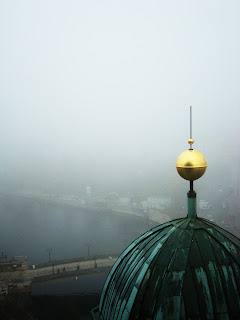
| View from atop the dome (it was very foggy) |
Western Berlin
Yesterday the fam and I headed off to the western part of Berlin to see the Olympic Stadium, city of Spandau, and Zitadelle. I had not been inside the stadium grounds (only outside the gates), so this was new for me. My favorite part was the bell tower, which puts you high up for a great view. Berlin has many such things, it seems--but they always cost money. Although Sean and I had been to the Zitadelle barely over a week ago, I still enjoyed climbing up the tower and walking along the bastions. It is such a cool place!
I have been attempting to speak some German when we are out (for instance, whiling ordering meals). I mess up... a lot. Yesterday, I peeked into a shop in Spandau, and an employee asked me a question in German. I had no idea what she was saying, but I assumed she was wondering if I would like help finding anything (or something along those lines). In English, I would say, "I'm good," so I replied with, "Ich bin gut, danke" ("I am good, thanks"). Sean later told me that this phrase does not have the same sentiment in German. Instead, I was basically saying that I was a good person. So the shop lady probably thought I was a weirdo...
| Olympic Stadium (the bell tower is in the distance) |
Tuesday, November 13, 2012
New Sites, Familiar Faces
This week my parents are in Berlin! They arrived on Sunday morning, when we went to the Gemäldegalerie art museum. It features works by artists such as Botticelli, Rembrandt, Durer, and Vermeer. On Monday, we gave them a tour of Mitte and some of the major Berlin sites. We started at the Reichstag, which has free tours of the cupola (reservations required--as well as identification). Neither Sean nor I had been in the cupola before, so we were quite excited to see it. As you wind your way up toward the top, you are treated to a great panoramic view of the city! We also saw the Brandenburger Tor, Holocaust Memorials (the one for Murdered Jews as well as the one for Sinti and Roma), Schloss Bellevue, and the Siegessäule. Sean and I went up into the Siegessäule for the first time. There is a small museum at the base, but of more interest to me was the beautiful mosaic a short stair climb away and the very top of the Victory Column a much longer stair climb away. We had another great view of the city, though by the time we made it to the top of the Siegessäule, the sun had set and only the city lights were visible.
Today we took the long train ride out to Potsdam to see Sanssouci Park, site of Frederick the Great's palaces: the summer palace, Sanssouci ("without concerns"), and the larger Neues Palais. We were able to tour portions of Sanssouci's interior. We saw a few guest rooms, which hardly seemed like guestrooms at all--the bed only occupied a small, recessed space and was covered by a curtain. All the rooms were very ornate. The one I would have wanted to stay in had a nature theme, with birds coming out of the walls and a flower chandelier. We weren't allowed to photograph the inside of the palace, but I found a picture on-line of the room (see third picture below). I was surprised (and maybe a little disappointed) that we didn't get to see any grand halls in Sanssouci, as I always imagine every palace must have one. My favorite part about Sanssouci was actually outside--the terraces at the back of the building (see first picture below). I liked the green gates, which housed some type of plant and are bordered by grape vines. Unfortunately, all the park's statues were covered by boxes to protect them from the winter weather (well, fortunately for the statues, I guess--just sad that I wasn't able to see them). I also liked the imposing Neues Palais, which Frederick used mostly just during the winter. After seeing these two palaces, we wandered through the town of Potsdam a bit, exploring its small shops along cobbled streets.
| Sanssouci |
| Reichstag Cupola with my parents |
![]() |
| Sanssouci's nature-themed guest room |
Saturday, November 10, 2012
Fashion
I have found that I am much more
obsessed with fitting in here than I was in the U.S. For instance, I
usually don’t care too much about keeping up with the latest fashions, but since
moving to Berlin I have felt more self-conscious. Sometimes I want to purchase an entirely new,
European wardrobe. I am even tempted to wear clothes that I would never
have bought in the States, like skinny-legged jeans or colored tights to wear
with skirts. I wear scarves on a regular basis now because nearly every
woman wears them here. When it was
warmer, I wore my silk scarf (thanks, Rebekah!) from home, and now that the
weather is cold, I wear my new, thick, tube scarf. I did bring a scarf with me (a lovely, long,
red scarf), but few Germans wear the long, winter scarves. Nearly everyone has huge tube scarves that
look like they’re about to devour your head.
Ordinarily, I would not buy this kind of scarf… But I did here. I do very much like it, though, so it was a
good buy, I’d say. You know, sometimes I
even worry that my hair looks too American.
I do hope that I am not going to turn into a fashion zombie living in
Europe!
Monday, November 5, 2012
Spandau and die Zitadelle
On Sunday Sean and I had a fabulous day exploring new parts of Berlin with our German friends, Regina and Dieter. We started with a stop at the Olympic Stadium (site of the 1936 summer games). The train station for the stadium has many platforms and is one of the cleanest I have seen. I was told that the station does not get used much (there's nothing other than the stadium there), except when there is a fuβball game. The station was renovated relatively recently, as Germany had hoped to host another Olympics in the 2000s (but they did not get the bid). We only saw the outside of the stadium, as it now costs money to tour inside.
From there, we headed to Spandau, which was once an independent town, before being consumed by Berlin. Older residents still speak of "going to Berlin," even though they technically live in Berlin. Spandau sits at the confluence of the rivers Havel and Spree. It has a small-town feel with a cute Altstadt (historic downtown) of cobbled streets and a beautiful church, similar to the one we saw in Bernau (except this one apparently has falcons nesting in its roof).
The coolest thing we saw in Spandau (and where we spent the majority of our time) was the Zitadelle ("citadel"). The Zitadelle is one of the largest and best-preserved Renaissance forts in Europe (built 1559-1594). Today it is used for tourism and the arts (it hosts frequent concerts and art exhibitions--there is even a children's art school on site). Here is an aerial photo, which was obviously not taken by me:
As you can see, the fort is an island. The four points are the bastions (approximately 300 meters apart, from tip to tip). It is hard to see in this photo, but in the bottom left corner of the "square," there is a small circle. This is the old watchtower (Julius Tower). You can climb up the spiraled staircase that hugs the wall of the tower to see from the top (about 30 meters high). It's a great view, extending all the way to downtown (can't miss the Fernsehturm). After descending the tower steps, we wandered around the perimeter of the Zitadelle. The left two bastions are currently open; you can walk across the grass and even stand at the very tip. You can reach portions of the right top bastion, but the lower right one is closed off completely. My favorite part was exploring the nooks and crannies of these bastions and the outer wall--it felt like a childhood fantasy come to life! The island also has a few small, historical museums (though mostly in German). It is perhaps sad that the highlight of the museums for me was a tiny model of Spandau with functioning spyglasses. I thought this was hysterical. I wonder if the spyglasses were installed in earnest or were meant to be cute... So, overall, the Zitadelle was great! I think it is one of my favorite Berlin sites now. Unfortunately, we did miss out on the bats. Many species of bat (die Fledermaus) winter in the Zitadelle's cellar, and you can apparently take tours to go see them.
| A look out point over the moat |
| Climbing Julius Tower |
| Sean and me atop the tower |
Friday, November 2, 2012
Bohnanza
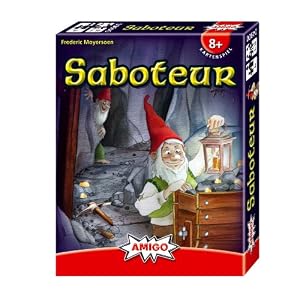
Recently, Sean and I decided to purchase a couple of German card games that we could bring back home and share with our friends and family (and pay much less than we would in the United States). One is called Saboteur and is like Resistance meets Labyrinth. You have one of two (secret) roles: gold-mining dwarf or saboteur. The gold-miners try to build a path to the gold, while the saboteur, obviously, tries to stop them. This game is designed for three or more people; thus, we have not yet tried it. Our other game, Bohnanza ("Bohn" = "bean"), is also technically for three or more players, but we make it work with just the two of us. I am now obsessed with this game. I could play it for hours. In fact, I'm pretty sure we have spent hours playing it, and we've had the game for less than one week. It reminds me of the game Dominion a bit, but less complicated. The goal is to harvest beans for coins. You draw bean cards and place them in your fields--but all the beans of one field must match, and you must play cards in the order you drew them.
Thursday, November 1, 2012
Sprechen Sie Deutsch?
Negotiation Phase: "the most important change in the period is communication: People adjusting to a new culture often feel lonely and homesick because they are not yet used to the new environment and meet people with whom they are not familiar every day. The language barrier may become a major obstacle in creating new relationships: special attention must be paid to one's and others' culture-specific body language signs, linguistic faux pas, conversation tone, linguistic nuances and customs, and false friends." (Wikipedia.org)
I frequently feel that if I knew German, it would help so
much in making me feel more at home in Berlin. I have encountered people
that speak English (some a little, some a lot)--even a few that switch to
English without your asking, but you cannot rely on the hope that you'll run
into such people. Also, most signs are not in English (though pizza is
the same word). I have been trying very hard to learn German, but I
frequently get overwhelmed and frustrated.
The system of German grammar seems to be beyond my comprehension, and
memorizing the gender of words is a never-ending battle... Sometimes I feel like I am actually making some progress, but other times, I feel like trying to learn a language in a few months is foolish and hopeless.
I like how the article above points out that there is more to a language than the words, and this nonverbal communication may differ between cultures. For the most part, I have found it very difficult to read Germans without knowing what they are saying. Granted, I've never been an especially intuitive person, but, here, I really seem unable to pick up nuances in tone, facial expression, or body language that might give meaning to what would otherwise be just words. For instance, when registering with the county and state, Sean came out with a very positive experience, thinking the government employees that helped us were really friendly. Did we see the same people? I thought, incredulously.
Actually, most of the friendliest people I've run into have spoken English. I am not suggesting English-speaking and friendliness are correlated--just that understanding the words makes a big difference. One German joked that Berliners smile for the tourists.... So maybe it's just a show because I'm American. I still appreciate it though.
Subscribe to:
Posts (Atom)