I had been wanting to go on a boat tour since arriving in Europe. I wanted to sail down the Spree, but the boat tour season was drawing to a close by the time we arrived in Berlin. I realized, though, that the Spree is not all that interesting. Then I wanted to sail down the Seine, but we had a lot to see in just three days (and you can see Paris better by foot, anyway). When we got to Dresden, I was determined to book passage for a trip on the Elbe. Sean was not quite as enthused, but I was able to convince him to go on the shortest tour (an hour and a half). In that time, we rode up the river, to the district of Blasewitz (a distance that would take approximately 15 minutes to drive), and then returned to Altstadt Dresden. On the way, we saw three Schlösser ("palaces"), though they didn't look like palaces to me (that term seems to be used very loosely in German), the unique houses of Blasewitz (there was once a law that every house there had to be different from every other), and the Blaues Wunder ("Blue Wonder"), a bridge which, in 1893, was pretty extraordinary due to its lack of central supports. On the tour, I also learned that the Dresden Elbe Valley was once an UNESCO World Heritage Site (2004-2009), but it lost the title with the construction of the Waldschlösschen Bridge. It is only the second site to be de-listed.
After deboarding and lunch, we headed to the Zwinger to visit the Mathematisch-Physikalischer Salon (as I wrote about in the post "Altstadt Dresden." And that wraps up our stay in Dresden.
On a side note, Dresden is very close to Meissen (about 25-30 kilometers), where Meissen porcelain is produced. Here is a brief background (from Meissen's web-site): "Since the early 13th century, Europe’s ruling houses had been importing porcelain at mind-boggling prices from China. Research aimed at cracking the secret of how porcelain was made commenced at Meißen early in the 18th century. Those involved were Johann Friedrich Böttger, Ehrenfried Walther von Tschirnhaus, the Freiberg Mining Counsellor Gottfried Pabst von Ohain and further mining and smelting specialists. The research was commissioned by Augustus the Strong, Elector Prince of Saxony and King of Poland. The work proved successful. The first white porcelain was produced in 1708 under the direction of Johann Friedrich Böttger. Europe’s first porcelain had been born."
Besides being known for its high quality, Meissen porcelain is also known for being expensive. There is an outlet store in Dresden, and we thought we would stop there and browse. It was the most awkward shopping experience of my life. As soon as we entered the store, a security guard followed us in and watched us intently. We approached the sales counter, and the woman who was there immediately stopped what she was doing and stood watching us as well. This made me feel so uncomfortable that I did not want to stay and look any longer. Plus, I noticed that a porcelain thimble cost over 20 euros, so I doubted we could afford anything anyway.
Tuesday, April 30, 2013

Festung Königstein
If you take the train south one more stop from Kurort, you arrive in Königstein. I would have liked to explore this place, with its narrow, cobbled streets meandering up and down hills, but we there, first and foremost, to visit the Festung ("fortress"). We could easily see the Festung because it sits on a very high hill (practically a mountain) above town. We just weren't sure how to get to it. At the tourist information center (which doubles as a post office), we learned that you can drive, pay 5 euros/person one-way for a rickety-looking bus, or walk. We opted for walking and once again found ourselves climbing up (and, once again, almost entirely alone).
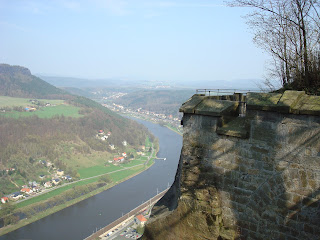 Eventually, we arrived at the Festung's base and after paying our entrance fee (we couldn't not go in after that trek), we took the elevator inside/to the top. The Festung is awesome. First of all, it looks like it is emerging from the rock, as though natural and man-made forces came together in its creation. Secondly, being on the highest point for miles, the view is breath-taking (and I had thought the Bastei vista was amazing...). You could spot barbarians, orcs, or any other enemy from a long way off and have plenty of time to prepare to battle before they arrived, breathless, at your front door.
The Festung was not always a fortress. Originally, it was built as a castle for the Bohemian kingdom (the earliest mention of it is 1233). In 1406, it fell into the hands of Saxon rulers, and in the early 1500s, the site was used as a monastery. Then, in 1589, it was converted into a fortress and served as a defensive retreat for royals and their treasures, as well as a prison (apparently the most feared in Saxony until 1922). From 1955 onward, the complex has been a museum. If you are interested in reading more about the history, this information all came from the Festung's web-site, and there is more detail there. I had thought I read that many objects were saved from the Dresden bombings because they were stored there during World War II, but now I don't remember where I found that information.
My favorite part about the Festung was being able to walk along the ramparts, from watchtower to watchtower. The fortress also has several buildings you can tour as well as some exhibits, but we only stopped by one: "Saxony and Napoleon--a Deal with the Devil?" All the information was in German, so I got little out of it, but Sean seemed to really enjoy this one-room, special exhibition (especially the case with Napoleon's hat). One could probably spend several hours at the fortress, but I was getting pretty worn out from our long day of hiking, and we wanted to be back in Dresden before too late. Consequently, we headed back down the mountain after only an hour or two. What a great end to our day in Sächische Schweiz!
 Eventually, we arrived at the Festung's base and after paying our entrance fee (we couldn't not go in after that trek), we took the elevator inside/to the top. The Festung is awesome. First of all, it looks like it is emerging from the rock, as though natural and man-made forces came together in its creation. Secondly, being on the highest point for miles, the view is breath-taking (and I had thought the Bastei vista was amazing...). You could spot barbarians, orcs, or any other enemy from a long way off and have plenty of time to prepare to battle before they arrived, breathless, at your front door.
The Festung was not always a fortress. Originally, it was built as a castle for the Bohemian kingdom (the earliest mention of it is 1233). In 1406, it fell into the hands of Saxon rulers, and in the early 1500s, the site was used as a monastery. Then, in 1589, it was converted into a fortress and served as a defensive retreat for royals and their treasures, as well as a prison (apparently the most feared in Saxony until 1922). From 1955 onward, the complex has been a museum. If you are interested in reading more about the history, this information all came from the Festung's web-site, and there is more detail there. I had thought I read that many objects were saved from the Dresden bombings because they were stored there during World War II, but now I don't remember where I found that information.
My favorite part about the Festung was being able to walk along the ramparts, from watchtower to watchtower. The fortress also has several buildings you can tour as well as some exhibits, but we only stopped by one: "Saxony and Napoleon--a Deal with the Devil?" All the information was in German, so I got little out of it, but Sean seemed to really enjoy this one-room, special exhibition (especially the case with Napoleon's hat). One could probably spend several hours at the fortress, but I was getting pretty worn out from our long day of hiking, and we wanted to be back in Dresden before too late. Consequently, we headed back down the mountain after only an hour or two. What a great end to our day in Sächische Schweiz!
Bastei
 |
| Basteibrücke |
From Kurort (which looked little more than a few city blocks), we used the ferry to cross the Elbe. I enjoyed the ferry ride very much (though its purpose is practical, rather than recreational). On the opposite side of the Elbe, lies the little, picturesque town of Rathen, nestled at the base of the Bastei rock formations. This was our starting point for the hike up to the Basteibrücke, which is a remnant of a castle once built on top of the Bastei. We had a bit of an issue finding the way, but fortunately we found someone to ask, and we learned that the tiny, unmarked path ahead of us was the right direction. We did not see anyone else on this path, but we were headed up and toward our destination, so we continued onward. Later, we found an alternate route, so perhaps most people use that one. I believe the majority of visitors, though, drive or take the bus to the parking lot at the top. But none of that for us!
 |
| View from the bridge |
From the Basteibrücke, we hiked back down, going the alternate route, where we found a trail leading to a lake, Amselsee. We followed this path and continued up to Amselfall ("blackbird waterfall"). The waterfall wasn't very impressive, but it was a beautiful area, at least. Overall, I loved our excursion to the Bastei, and felt this one morning was enough to make our whole trip to Saxony worthwhile. But we still had a whole afternoon to explore Sächische Schweiz, so we headed on to another destination: Königstein...
Monday, April 29, 2013
Rühstädt
 |
| Bulletin posting year ("Jahre"), arrival ("Ankunft"), young ("Junge"), and departure ("Abflug") for individual stork nests. |
 |
| Map with stork nest locations throughout town |
Rühstädt is tiny and quiet. It is northwest of Berlin and lies along the Elbe. I think that most of the people we saw were from out-of-town, there to see the storks, like us. Nearly all the buildings are red brick and several roofs have wooden platforms. And on these platforms are huge nests, and in the nests are storks! You can see at least one nest from practically any point in the town (they are that numerous and the town is that small). At one look-out point, we could see nine! We wandered about the streets, constantly spotting more stork couples, and we took lots of photos (Regina suggested we like stork paparazzi). You can see some of my stork pictures on my photo site. They are such beautiful birds! They also make interesting calls, by clapping their beaks.
Rühstädt very much embraces its claim to fame as a Storchendorf. Stork figures are abundant, and maps throughout town indicate the location of all the nests. Each nest has a bulletin near-by that records the arrival date of each stork (the male and female), the number of eggs hatched, and the departure date for each year. Tours are available during the summer, and we even came across a souvenir shop with stork stuffed animals and stork key chains. I purchased a small, stork pin.
We also stopped for lunch in Rühstädt. The restaurant featured German food, so I was a bit worried I wouldn't find something I'd like. Fortunately, I had something tasty (I don't remember the name, but my meal was a lot like fried mozzarella sticks, except with Camembert inside).
 |
| The stork on the left plucked some materials from a nearby, empty nest. |
P.S. I encountered advertisements on paper towels for the first time in Havelsburg, in the church's bathroom. This concept was so novel to me that I took an extra paper towel as a "souvenir." I am guessing that perhaps the church gets monetary support from local businesses, and, in exchange, they ask for advertising space in the restrooms.
P.P.S. I still plan on writing more about Dresden soon!
Saturday, April 27, 2013
Altstadt Dresden
 |
| Frauenkirche in the Neumarkt Square |
 |
| The Zwinger's courtyard |
 |
| Inside the Festung |
 |
| Altstadt Dresden |
One thing I loved about Dresden was the river. I knew that the Elbe cut through the city, but I imagined a river like the Spree in Berlin or Seine in Paris. These rivers are tightly bounded by their cities' infrastructure. They don't even look like natural rivers anymore, but rather canals, with sides of stone. Although the water is not clear enough to see to the bottom, I imagine it being stone as well. The section of the Elbe that cuts through Dresden, on the other hand, actually looks like a real river. The bank along Altstadt is built up, to allow boats to dock, but the other side is bordered by grass. You could walk straight into the river, if you wanted (I saw lots of dogs swimming while we were there).
Friday, April 26, 2013
Travels to Saxony
On Monday, Sean and I rode the train to Dresden. If trains were faster, I would argue that they are the ideal way to travel. It is better than driving because you have more leg room and you can get up and stretch your legs. You can even use the bathroom (though I wouldn't recommend it merely for the experience--use only if you must). Although you need to be on time for your train and thus do not have the luxury of setting your own schedule, you don't have to arrive nearly as early as you would for a plane because there is no security. This means you can bring whatever you want (no rushing to the store when you realize you don't have an eight ounce bottle of shampoo) and you are only limited in weight and quantity by what you can carry. The scenery is better than in a plane as well, since you get to see country, rather than just sky and clouds. Since you are not at the wheel yourself, you can actually enjoy the landscape or even take a little nap. I did both on our train ride. I saw several deer, a hawk, and two cranes. If only the train weren't so slow! Sometimes it is even slower than traveling by car. But this post is not about trains; it is about Dresden.
The primary reason we chose to visit Dresden was its vicinity to Berlin (closer cities are cheaper to travel to by train). Before I did some travel planning, I did not really know much about Dresden, other than that it had been bombed heavily during World War II. I was not sure if there would be much of interest to see there actually, but based on the city's tourism site, it looked quite lovely. Apparently, within the last twenty years or so it reconstructed many of its original buildings. It was Baroque, so they had to fix it, as Cogsworth would say (and yes, the architecture is Baroque, so this pun actually works here)! After some research, I also learned that Dresden is next to a forested, mountainous region known as Sächische Schweiz (Saxon Switzerland). I couldn't pass up the opportunity for some hiking! Thus a trip to Dresden looked promising, and we planned to stay two nights, spending the middle, full day in Saxon Switzerland, visiting, in particular, the Bastei Steine (Bastei Rocks). Well, our little trip exceeded my expectations. Our three days in Saxony were lovely. I loved Dresden (it was definitely worth a trip for more than just being close to Berlin). It was beautiful (it's one of the greenest cities in Europe, with about 63% of its area being green space, by the way), and the people seemed overall quite friendly. I especially loved Saxon Switzerland and its quaint, little towns, nestled along the gorgeous Elbe River. I have shared my favorite photos on Picasa (linked to the right), so you can see a preview of our trip there. Note: the pictures uploaded in a strange order, so they are not chronological. Sorry if that's confusing!
I will write all about our time in Saxony over the course of several posts, but, for now, I will leave you with a brief geography lesson. Germany is divided into sixteen Länder (literally, "lands," but they function much like our states). Berlin is its own Land (so it is called a Stadtstaat, or "city state"). The state surrounding Berlin is Brandenburg (we've been to this one too, as it is the location of Potsdam, with the palace Sans Soucci). We have now been to another state, Saxony, twice (with our travels to Leipzig and Dresden). Leipzig is the largest city in Saxony, and Dresden is its capital and second largest city. Dresden is about 200 kilometers south of Berlin and is very close to the Czech Republic (at one point, when we were in the town of Königstein, we were only about 16 kilometers from the border).
 |
| Gasse ("alley") of Dresden |
I will write all about our time in Saxony over the course of several posts, but, for now, I will leave you with a brief geography lesson. Germany is divided into sixteen Länder (literally, "lands," but they function much like our states). Berlin is its own Land (so it is called a Stadtstaat, or "city state"). The state surrounding Berlin is Brandenburg (we've been to this one too, as it is the location of Potsdam, with the palace Sans Soucci). We have now been to another state, Saxony, twice (with our travels to Leipzig and Dresden). Leipzig is the largest city in Saxony, and Dresden is its capital and second largest city. Dresden is about 200 kilometers south of Berlin and is very close to the Czech Republic (at one point, when we were in the town of Königstein, we were only about 16 kilometers from the border).
Friday, April 19, 2013
Nudity
Yes, that's right, nudity. Is this really an appropriate topic, you may be wondering. Well, given my current context, I would argue yes--or, at the very least, it is relevant. For Americans, nudity has a lot of taboos. It is, for the most part, reserved for the private sphere, and when it enters the public realm, it must be discreet. Germany is not like this, and I found this quite shocking at first--more, I'd say, than any other aspect of German culture I've encountered thus far (the second most shocking was probably public drinking, which is not illegal here). I will admit that I can be a bit prudish, even for an American, but surely I am not the first foreigner to raise an eyebrow at Europe's normalization of nudity?
I should have been more prepared. I had heard Sean's story about wandering through the Tiergarten and unwittingly passing through the nude section on his first trip to Berlin three years ago. Thus I knew, beforehand, that parks had clothes optional sections. Still, I had not imagined these sections being so, well, spacious and open--and popular. Or that you might happen upon naked sun-bathers in other parts of the park as well. I also had not expected to see so much nudity in advertisements, magazines, and museums. For example, at the DDR Museum, there was a section on the popularity of nude beaches in East Germany. The museum had a display of naked miniatures playing volleyball--as well as photos and even video footage of a family running into the ocean in nothing but their birthday suits. This exhibit was shocking to me on two accounts: 1. I had not noted any warning or indication anywhere that the museum contained "mature" content that may not be suitable for all ages, and 2. even children were portrayed in the buff. What I gathered from this and other experiences I've had since moving here is that nudity is not hidden from children, nor is it taboo for children to be nude themselves.
I recall browsing through a rack of magazines at one point back in the fall, when I noticed an "adult" magazine. I was shocked that the cover model revealed all, yet no black screen blocked this photo from view, as I am used to in the States. I was very concerned at the time. I remember ardently whispering to Sean, "Children could see that!"
At the Film and Television Museum, there was a case of old magazine clippings. The theme of the display was Sesamstrasse, so the advertisements featured characters like Bert and Ernie. I recall that one had a child taking a bath or shower, and the child was not wearing anything. I felt like I shouldn't even be looking at such things and promptly turned and walked away. I am guessing this would not be the typical German reaction. At the time, I had assumed these were ads of the past and one wouldn't find such images in use today... Well, Sean and I were perusing the games at a toy store recently, and I noticed a display for bathtub crayons. A video showed children using the product, drawing on the walls of the bathroom. In every commercial I can think of featuring children taking baths in the United States, the kids are either covered up by bubbles or are wearing swimsuits (with the exception of babies). Not the case with this German ad.
When I first starting noticing the nudity, I tried to be reasonable and open-minded. Maybe these Germans have got it right. Maybe they have a healthier relationship with their bodies. Why does something so natural have to be so wrong anyway? Must I be so embarrassed by the naked human form? Turns out the answer is YES. Sorry, Germany, but I'm still not quite comfortable with that 60-year-old man sunbathing without any clothes. Those Puritanical roots of American society run too deep in me, I guess. I am no longer shocked (too much), but I am certainlynot assimilated.
 |
| Statue at the Tierpark Zoo |
Thursday, April 18, 2013
A Day In the Life
This afternoon we hopped on the Ring train (the one that makes a loop around the city) and rode to Gesundbrunnen station, from which we walked to Volkspark Humboldthain. We leisurely strolled about the grounds, taking in the local flora and fauna (like a cute red squirrel with the tufted ears), and explored the hill that once served as an anti-aircraft platform. Then we headed to the mall to cool off (it went from cold to hot in a matter of days here in Berlin). I wandered into a clothing store (H & M), tried on some garments, and bought a skirt and dress for twenty euros. Sean, meanwhile, got two scoops of pistachio gelato. Then we rode the train back to our stop, walked to our complex, and up the stairs to the fourth floor (American fifth floor). We opened the windows to air out our warm, stuffy apartment, and after a short break, we grabbed our re-usable grocery bags and Pfand bottles* and walked to the grocery store. We shopped (we had enough items on our list that we pulled out a euro for the deposit on a shopping cart), checked-out, and bagged our purchases. Then we walked home, put our food away in our mini fridge and ate dinner.
Here is what my day would have been like in the United States:
This afternoon we drove to the park. We leisurely strolled about the grounds, taking in the local flora and fauna (like grey squirrels), and explored the hill. Then we headed to the mall to cool off. I wandered into a clothing store (Macy's**), tried on some garments, and bought a skirt and dress for $26. Sean, meanwhile, got two scoops of ice cream. Then we drove back to our complex and walked up the stairs to the second floor. We turned up the air conditioning because it was warm and stuffy in the apartment, and after a short break, we grabbed our re-usable grocery bags and drove to the grocery store. We shopped, checked-out, and thanked the bagger for bagging our items. Then we drove home, put our food away in the fridge and ate dinner.
*I don't know if I've talked about Pfand bottles before, so I thought I should clarify. Pfand means "deposit." In Germany, when you buy beverages in glass and plastic bottles, you pay a little bit extra to cover the cost of the bottle (15 or 25 euro cents). When you have finished your beverage, you can return the bottle to a grocery store, put it in a machine that scans it and gives you a receipt for that little extra you paid. You then take the receipt to the cashier for cash or it can go toward your purchase.
**Macy's is not exactly the equivalent of H & M, but I chose it because both are recognizable, everywhere, affordable(ish), and usually have the largest store in the mall. H & M caters mostly to a younger crowd than Macy's, though. I think there are H & M's in the U.S. too, so I am assuming the styles sold are the same.
Wednesday, April 17, 2013
The DDR Museum
This is rather old news, actually, but I never got around to writing about our visit to the DDR Museum. I've probably mentioned this before, but DDR stands for Deutsche Demokratische Republik (or German Democratic Republic, GDR, in English). Reminders of the DDR are pervasive throughout Berlin. Museums and memorials tell of a dark time, when people were spied upon by their own government and constantly subjected to controlling measures. Berlin is very much a city about not forgetting, and if you spend enough time here, it becomes very clear that Berliners do not want anyone to forget that the years of the DDR were a desperate time, when citizens would risk everything, even their lives, for the chance of escape. On the other hand, for Eastern Germans/Berliners, this was life--and, for many, the only one they knew. So, alongside the grim, one finds evidences of the everyday. For example, Ostalgie* trinkets and souvenirs are pervasive. One can shop stores dedicated to all things Ampelmann but just as easily find the traffic light man's likeness in malls and bookstores. We even went into a shop in Leipzig which sold products from the period, from shampoo to food (this would have been very useful for the son in "Good-bye Lenin," I noted to Sean). Furthermore, in Berlin there is a tour known as Trabi Safari, in which one drives around town in one of these old, plastic cars ("Trabi" is short for "Trabant," by the way). Most of the educational material on the DDR, however, seems to focus on the government and the Wall, but I kept wanting to know how people lived between 1949-1990. This is why we decided to visit the DDR Museum.

The museum claims to be one of the most interactive in the world. I'm not quite convinced of that... I hope they aren't counting the opening of doors and pulling out of drawers one has to do in order to read the text concealed inside (which I wasn't very fond of actually, for two reasons--1. only one or two people could read any one display at a time, and 2. I couldn't help but think of all the germs I was collecting along the way...). But you can hop in a Trabi, or browse through a closet of clothes. There's a sample apartment set up, with a living room, bathroom, and kitchen. Some of those doors I was talking about have computer games inside, like one I played in which the goal was to dress a DDR man or woman in the proper attire (and proper accessories), which was neat. No topic was really explored in-depth (it's not that big of a museum), and, at times, I would have appreciated a little more detail, but I did like the breadth of information (Sean later told me that some of the points that confused me are either common knowledge in Germany or such a vast topic that you can't easily explain it in a sentence or two). The museum does a good job at presenting multiple facets of life in the DDR, such as employment, education, recreation, and fashion, and how these elements were all affected (and in many cases, controlled) by the state.
*Ostalgie referes to nostalgia for certain aspects of the DDR. It is derived from the words "Ost" (meaning "East") and "nostalgia." There is a bit of controversy surrounding this term. As Theo Mitrup, head of a Berlin support group for people persecuted under the DDR, pointed out, "There's nothing wrong with recalling the past--indeed--people even probable have happy memories of everyday life under the Nazis--but it's a question of balance. This nostalgia seems to ignore the oppression, the secret police, the intimidation--history is somehow being rewritten." You can read more about this topic in the BBC article linked above. The article is from 2003, but I believe the sentiments expressed are not out-dated.

*Ostalgie referes to nostalgia for certain aspects of the DDR. It is derived from the words "Ost" (meaning "East") and "nostalgia." There is a bit of controversy surrounding this term. As Theo Mitrup, head of a Berlin support group for people persecuted under the DDR, pointed out, "There's nothing wrong with recalling the past--indeed--people even probable have happy memories of everyday life under the Nazis--but it's a question of balance. This nostalgia seems to ignore the oppression, the secret police, the intimidation--history is somehow being rewritten." You can read more about this topic in the BBC article linked above. The article is from 2003, but I believe the sentiments expressed are not out-dated.
Saturday, April 13, 2013
Birds of Berlin
One of my favorite things to do in Berlin is bird watch at Volkspark Friedrichshain. You may recall that I have mentioned this neighborhood park on more than one occasion in previous posts. I believe that this place, more than anything else in Berlin, makes me feel at home here. If you know me well, you probably can understand why having a little piece of nature near-by is so important to me. But back to the birds. Most species wintered elsewhere (except for the conspicuous hooded crows and rock pigeons). A lone grey heron remained for much of the season as well, though I haven't seen him (or her) lately. Now that the weather is finally starting to warm up, though, all the other birds are coming back--some familiar species from the fall and some brand new. One of my favorites is the wood pigeon, which looks a lot like a regular pigeon but is larger. A pair regularly shows up in our courtyard in the mornings (announcing themselves with their characteristic coo), and I enjoy pointing them out whenever they land on our balcony. They are very difficult to photograph, as they seem to guess my intentions and fly away just as my camera is turning on.
All of these pictures are on my photo site, but I'm putting them here too, with the German names for the birds.
Most of the birds I spot are much too elusive (or too far away) to be photographed, so here is a list of other birds I've seen (with links to their pictures, if you'd like to know what they look like):
All of these pictures are on my photo site, but I'm putting them here too, with the German names for the birds.
 |
| Ringeltaube (Wood Pigeon) |
 |
| Graureiher (Grey Heron) |
 |
| Rotkehlchen (Eurasian Robin) |
 |
| Höcherschwan (Mute Swan) |
 |
| Blässhuhn (Eurasian Coot) |
 |
| Kohlmeise (Great Tit) |
 |
| Blaumeise (Blue Tit) |
 |
| Nebelkrähe (Hooded Crow) |
Most of the birds I spot are much too elusive (or too far away) to be photographed, so here is a list of other birds I've seen (with links to their pictures, if you'd like to know what they look like):
- Amsel (Common Blackbird) -- These birds have simple plumage (all black), but I find them to be so beautiful, especially with their orange beaks and the bright, yellow ring that encircles their eyes. They also have lovely calls.
- Eichelhäher (Eurasian Jay) -- I saw one of these for the first time today. They are bigger than they appear in the pictures (closer to magpie size).
- Elster (Eurasian Magpie)
- Wintergoldhähnchen (Goldcrest) -- I spotted this one for the first time today as well, flitting about on the ground. I love that golden crest!
- Gartenbaumläufer (Short-toed Treecreeper) -- I think this is the bird I saw... It certainly had the long beak. It was hopping up a tree, like a nuthatch does, so that it looks almost like the birds is sliding along the bark.
- Stockente (Mallard) -- No link here since I'm assuming everyone has seen a Mallard duck before.
- Bachstelze (White Wagtail) -- I spotted two of these interesting birds at the small pond at the park. True to their name, they kept wagging their tails, as well as swooping close to the surface of the water and then hovering, almost like hummingbirds.
- Teichhuhn (Eurasian Common Moorhen) -- I've seen these on multiple occasions, but only just figured out what they are called. Apparently, moorhens live in the United States as well (just not in the Great Plains region). I like their big feet!
- Mandarin Duck -- These are not native to Germany (they're an Asian species), but I see them quite a bit, and they are always one of my favorites at the pond. So beautiful!
Thursday, April 4, 2013
Dogs
You may recall that I already wrote a post about dogs in Berlin, back in the fall. I have had dogs on my mind a lot lately (missing my Shiba from home and day-dreaming about our future dog), so I was inspired to write more for all my fellow dog-lovers. Oh, and on a somewhat related note (the connection being pets), I have seen at least two cats in this city. For a few months, I wondered if Berliners kept cats at all, but I did spot on peering out of an apartment window one day and another meandering down our street earlier this week.
As I mentioned in the previous post, dogs seem to go everywhere in Berlin. They ride on trains and enter stores (allowance of the second still surprises me). The only type of store where I've seen dogs tied outside (or just waiting at the entrance, leash-less, with their noses mere centimeters from the door) is the grocery store. I wonder if, perhaps, dogs are welcomed, or at least tolerated, in so many places because they are extraordinarily well-behaved and very obedient here, with few exceptions. Rarely have I heard a dog bark, and I don't recall ever seeing one jump up on a person, even in play. Nearly all the canines in Berlin conduct themselves like work dogs in the States. They do not seem to be easily distracted, and they practically ignore all people other than their owners. It also seems to be socially unacceptable to notice other people's dogs, much less to ask to pet them (this extends even to children). Like owners of work dogs in the States, Germans usually show little affection for their animals in public. Despite this frequent air of aloofness, I have no doubt that Germans love their pets very much, as evidenced by their desire to bring them everywhere with them.
Many of the dogs here look like mixed breeds to me, but I don't know if they truly are, or I just don't recognize the breeds (perhaps they aren't quite as common in the States). Most dogs are small to medium in size and of stocky build (generally, ranging in size from a pug to a boxer). Tiny, delicate dogs are rare, as are huge breeds (the latter may be due to the fact that most Berliners live in apartments).
Wednesday, April 3, 2013
Normalcy?
I do believe that after six months, I am on the verge of that most-coveted state of normalcy. I realized this week that I am no longer constantly aware of the strangeness of even very simple day-to-day activities. Trekking back from the store, hands loaded with grocery-filled re-usable bags is normal. Bagging our items ourselves is normal (though now we've adopted the "put the groceries in the cart first, and then bag them off to the side after we've paid" strategy whenever we have a large number of items). Certain foods from my American diet, which I once craved regularly, are not being craved quite so often. Hopping on public transport for all our traveling needs is so routine. Even the once funny smell of the U-Bahn stations isn't so bothersome to me anymore. I'm still not fond of certain aspects of our living arrangements, but they don't drive me crazy as they once did. And although Berlin is still not a city in which I'd like to remain, I've grown more or less used to its quirks--and those of its people. My excitement at returning to the States however, is just as strong as ever. Even though I was able to visit family and some friends in December, it feels like it has been much longer than three months since we've seen loved ones. Additionally, I long to have our own place again. Living in someone else's apartment is not nearly as awkward now as it was when we first arrived, but I doubt it could ever truly feel like home.
I wonder, is normalcy achievable now because I've had six months to adapt to life abroad--or because I anticipate our return to the States in two months? Would I be as accepting of our lifestyle, for instance, if we were planning to remain here indefinitely? Most likely, both factors are contributing to my growing sense of comfort.
I wonder, is normalcy achievable now because I've had six months to adapt to life abroad--or because I anticipate our return to the States in two months? Would I be as accepting of our lifestyle, for instance, if we were planning to remain here indefinitely? Most likely, both factors are contributing to my growing sense of comfort.
Monday, April 1, 2013
All Quiet
I realized that it has been over a week now since I have written anything new--solely because I haven't come up with anything post-worthy. I will not attempt to exhaust your patience with my lament of the weather, especially since I know that much of the United States is also experiencing an unusually long winter, but the cold has kept us mostly confined to the apartment since our return from Paris. I will gladly talk about the games we've been playing, books I've been reading, projects I've been working on, and other such indoor activities that have occupied me over the last week for those interested, but such small diversions seem less than note-worthy for a blog post. We have been planning a couple of short trips for our last two months in Europe. In April, we will spend two nights in Dresden, which is about 200 km (~124 miles) south of Berlin. Nearby is the area known as Saxon Switzerland (which is closer to the Czech Republic, not Switzerland, as might be assumed from the name), and we hope to make it to the section with the Bastei Bridge for some much-needed communing with nature (and other nature-loving tourists...). In May, we plan to spend one night in Stralsund, which is a coastal city along the Baltic Sea. In the mean-time, my challenge is to come up with interesting topics to write about... Oh, did I mention that we now have only two months left before we return to the States?
Subscribe to:
Posts (Atom)