 |
| Frauenkirche in the Neumarkt Square |
On our first day in Dresden, we decided to explore the Altstadt (literally, this means "old city;" the term frequently refers to a historic downtown). As I mentioned in the previous post, much of Dresden had to be re-built after World War II, and reconstruction of its lost treasures, such as the Frauenkirche (Church of Our Lady), Royal Palace, and Semper Opera House, was only completed within the last twenty or so years. Personally, I could not tell that these structures were not as old as the originals from the 18th and 19th centuries--though the non-stone buildings all looked very bright and new, such as the shops around Neumarkt Square (including a Wempe jewelry store). I thought it was all quite beautiful and charming.
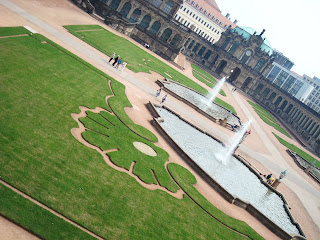 |
| The Zwinger's courtyard |
One of my favorite buildings was the Zwinger, which had a pleasant courtyard with fountains. A
Zwinger is an outer ward of a castle. This one was originally used as an orangery (to house citrus plants) and later an exhibition center. Currently, its wings house four museums: the Old Masters Picture Gallery, the Armoury, the Porcelain Collection, and the
Mathematisch-Physikalischer Salon. We visited the latter on our last day in Dresden. This was something Sean really wanted to see, but I ended up finding it interesting as well. The Salon displays old objects of science and mathematics. You see devices that are mechanical (clocks) and experimental (vacuum pumps, burning mirrors), as well as tools for calculating, measuring (astrolabes), exploring (telescopes), and recording (globes).
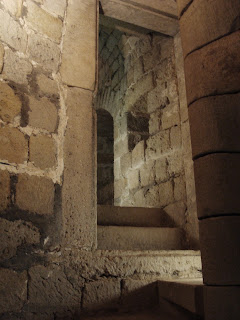 |
| Inside the Festung |
The other museum we visited (on day 1) was the Dresden Festung ("fortress"). This one was my idea, and I'd say it was a good one! The city began building on top of the old, Renaissance fortress, so that the structure is now underground, lying beneath the Br
ühl Terrace. Today you can still see portions of the outer wall, which appear to be holding up the Terrace and near-by Academy of Arts building (in the top photo, this area is located on the other side of those white boats). The museum is rather small (but still worth it, in my opinion) and entails wondering through excavated portions of the fortress, with a few signs describing the rooms' original purposes. The fortress was dark and damp like a cave, and I was very intrigued by what appeared to be cave formations on the ceiling of one small chamber and the walls of a hallway (the former looked like early soda straws, and the latter like bacon). I thought it amazing that this natural process, years in the making, was starting up in this man-made cavern. Sean pointed out that mortar used to be made with shells, so the fortress likely has a source of calcium carbonate.
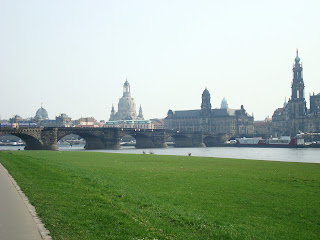 |
| Altstadt Dresden |
One thing I loved about Dresden was the river. I knew that the Elbe cut through the city, but I imagined a river like the Spree in Berlin or Seine in Paris. These rivers are tightly bounded by their cities' infrastructure. They don't even look like natural rivers anymore, but rather canals, with sides of stone. Although the water is not clear enough to see to the bottom, I imagine it being stone as well. The section of the Elbe that cuts through Dresden, on the other hand, actually looks like a real river. The bank along Altstadt is built up, to allow boats to dock, but the other side is bordered by grass. You could walk straight into the river, if you wanted (I saw lots of dogs swimming while we were there).


No comments:
Post a Comment