 |
| Typical street in Stralsund |
On Saturday we returned from a one-night stay in the coastal city of Stralsund (located in the state of Mecklenburg-Vorpommern). Stralsund is about a three hour train ride north of Berlin, on the Baltic Sea. It is one of several Hanseatic cities in northern Germany, which refers to towns that were once a part of the
Hanseatic League (a confederation of merchant guilds and their cities). Most sites referring to Stralsund use the term "Hanseatic" as though everyone should know this word. I did not, but it seems like it was a pretty big deal (follow the link if you want to read more). The
Altstadt ("old town") of Stralsund is a UNESCO World Heritage Site, and retains much of its
Brick Gothic architecture from as early as the 13th century. It is practically an island, being surrounded almost entirely by lakes (man-made, I believe) on one half and the Baltic on the other half. The streets are very compact and narrow, and they are lined with compact buildings (though this is not uncommon for Germany). We spent our first day in Stralsund (Friday) wandering around this historic downtown, as well as exploring the harbor and coast. My favorite part of the day was simply strolling down a quiet, seaside path winding north of town. I especially enjoyed walking along the waves at their beach (which most likely was a man-made beach, but I didn't care).
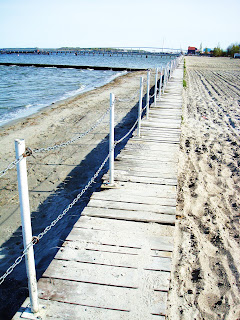 |
| The beach |
On Saturday morning, we headed to the Ozeaneum, which is part oceanography museum and part aquarium. I was most interested in the living exhibits, but the Ozeaneum had great educational sections too, which provided information on topics such as oceanography, marine biology, and environmental concerns. My favorite display was a mass of magnified, plastic plankton hanging from the ceiling. I got the impression that the other visitors were not nearly as excited as I was, but I guess I've spent more time looking through scopes than the average person. The aquarium sections primarily featured species from the Baltic and North Sea (the two seas that touch Germany), so I got to see a lot of neat, new species. My favorites were the lumpsuckers (I'd seen tiny ones at the Georgia Aquarium, but the Ozeaneum had species approximately 5-7 inches wide) and the anglerfish (which was translated as "football fish").
After the Ozeaneum, we took an hour and half boat tour through the waters around Stralsund (I don't know the technical term here... bay, canal, etc.). There were no English translations (unlike the Dresden boat tour), so I did not learn anything, but I signed up just for the fun of riding on a boat anyway. From there, we headed back to the Hauptbahnhof (main train station) to return to Berlin.
For the trip to and from Stralsund, we rode a regional train (rather than the high-speed ones), and these are not quite as nice (or comfortable). I did, though, see more wildlife than on any of our other trips! I spotted hares, deer ("Rehe"), cranes, foxes (including a mother and her kits, which was awesome!), a pheasant, and an animal I had been hoping I'd see before we left Germany: a wild pig ("Wildschwein"). In fact, after I saw the pheasant (heading toward Stralsund), I told Sean, "Now all I need to see is a Wildschwein." He didn't think I'd see one. But, shortly after, I saw something very large and very hairy in the woods! Granted, we were traveling quickly and trees frequently play tricks on the eyes, but I am 90-95% sure I saw a wild boar. On the way back, I told Sean I wanted to see a pig again. He said that wouldn't happen. But I saw another one--albeit a much smaller individual! Then Sean said I wouldn't see another one, but I did!


